

Relay Technology in Modern Climate Control Systems
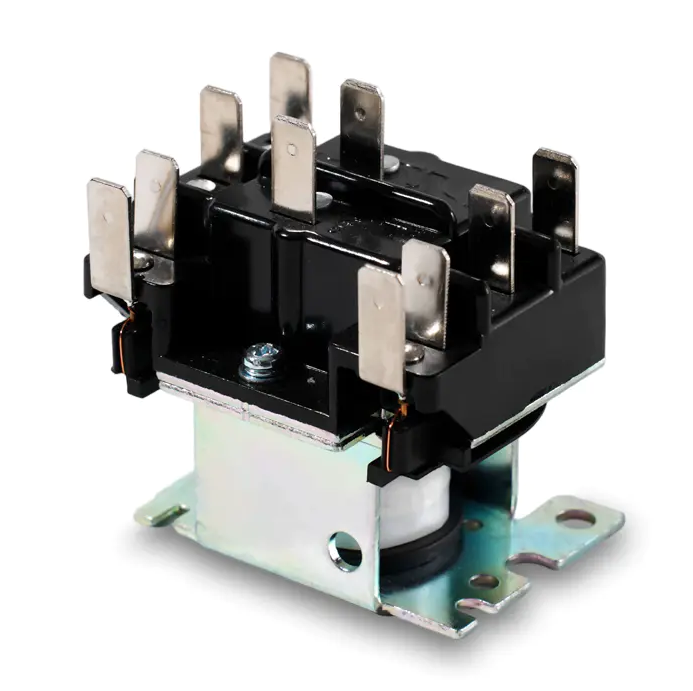
The evolution of HVAC systems toward automation and smart control has increased the importance of reliable switching components such as the HVAC Control Relay. These relays are now integrated into IoT-enabled controllers, building management systems (BMS), and energy optimization platforms.
Modern HVAC Control Relay designs often incorporate:
Solid-state switching options with zero-cross detection
Hybrid relay structures combining mechanical and semiconductor elements
Low-power coil consumption below 0.5W in standby modes
In smart HVAC systems, relays are controlled by microcontrollers operating at 3.3V or 5V logic levels, allowing seamless integration with sensors and cloud-based control systems.
Load switching requirements remain demanding. Compressor circuits may involve starting currents of 30A–60A, requiring relay coordination with contactors to prevent inrush damage.
Communication protocols such as Modbus or BACnet do not directly drive loads but instead trigger relay logic modules, which execute physical switching actions within milliseconds.
Environmental reliability is critical. Many HVAC Control Relay units are designed with sealed enclosures rated at IP40 to IP67, protecting against dust and humidity in industrial or outdoor environments.
Future HVAC systems continue to integrate predictive control algorithms, where relay switching cycles are optimized based on load prediction models, reducing unnecessary switching events and extending component lifespan.

 English
 Arabic
 French
 Spanish
 Portuguese
 Deutsch
 Turkish
 Dutch
Dutch
 Russian
 Romaian
 Portuguese (Brazil)
 Greek
Greek