

Emerging Standards and Protocols: A Detailed Look at the Latest In-Vehicle Networking Market Trends and Technological Innovations
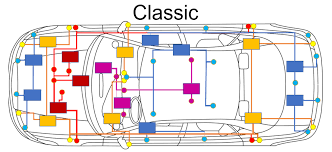
The world of automotive communication is currently witnessing a rapid "standardization war" as different protocols vie for dominance. In the In-Vehicle Networking Market, the trend toward consolidating diverse functions into a single, unified network is gaining momentum. Historically, a car might have used LIN for mirrors, CAN for the engine, and MOST for media. Today, the move is toward a "One-Network" approach using Time-Sensitive Networking (TSN) over Ethernet. As we deliberate on these In-Vehicle Networking Market trends, it is clear that the goal is to create a deterministic environment where safety-critical data is guaranteed to reach its destination within a specific timeframe. This is a massive shift from the "best-effort" delivery seen in standard office networking. We should discuss how these trends are enabling features like high-fidelity 360-degree camera views and augmented reality head-up displays, both of which require perfectly synchronized data streams.
Another major trend is the move toward "decentralized" intelligence. While the central brain of the car (the domain controller) is important, we are seeing more processing power being pushed to the "zonal" hubs. These hubs act as local data aggregators, filtering and compressing information before sending it to the central processor. This reduces the load on the main network and allows for faster local decision-making. Our group should also explore the trend of "functional safety" in networking components. It is no longer enough for a chip to be fast; it must also have built-in self-diagnostics to detect and report internal failures. This is a critical requirement for moving toward higher levels of autonomy where the human driver is no longer the primary backup. As we look at the hardware, the trend toward miniaturization is also evident, with smaller, more ruggedized connectors and thinner, lighter cables becoming the industry standard to save space and weight in increasingly crowded vehicle chassis.
What is Time-Sensitive Networking (TSN) and why does it matter? TSN is a set of standards that allow for deterministic communication over Ethernet, ensuring that time-critical data (like steering commands) is never delayed by less important traffic.
How do zonal hubs improve network efficiency? Zonal hubs act as local gateways that process and aggregate data from nearby sensors, reducing the volume of traffic that needs to travel across the vehicle's central backbone.
➤➤➤Explore MRFR’s Related Ongoing Coverage In Semiconductor Domain:
Level Measuring Equipment Market
Litigation Funding Investment Market

 English
 Arabic
 French
 Spanish
 Portuguese
 Deutsch
 Turkish
 Dutch
Dutch
 Italiano
 Russian
 Romaian
 Portuguese (Brazil)